Wednesday, December 22, 2021

Mindful Writing Mantra and Essay [Excerpt]: Guest Post by Salem State University Student


Some Ideas are Fertilizers for Other Ideas


Billy Reddy

Billy Reddy is a senior at Salem State University in the Geography Department, graduating this semester. He'd call himself a lifelong learner and hopes to continue the pursuit of knowledge in his post-college life. 

...Seeing the impermanence and the constant flow from one state to another that I experienced when we practiced moment tracking in this course helped me to realize that some ideas or more, so their half-baked form are part of the process. 


I started to see that these disjointed fragments are like steppingstones in a river and can be used to get from one place to the next. I began to see the writing process as a lot like hiking: for both it is about the journey and the destination. Each small step is important to reach the peak of the mountain, just as all words, even the ones that don't make it to the published draft, are important and make up a greater whole. But for some reason we agonize over the words in front of us. 


Imagine, especially if you have ever been on a long hike, if we stopped every step on our way up the mountain, agonizing if it was the exact right step on the path. We would never get to the top if we hiked that way. So, what is it about writing that makes this method seem like a good idea?  


I'm not sure what it is that causes this problem: maybe it's audience or the monkey mind? Where do we get the idea that first and final form are one in the same? Where does this deep feeling of attachment come from? Why does it feel like the words typed out in from of me define who I am? Is each fumble at a word or first pass of a phrase an indicator of my intelligence?  


Why does it feel that this rough draft is a representation of who I am?  


When we write, it's like Michelangelo releasing David from the colossal slab. The difference here is that with writing comes an extra step in the process. The writer must first create the slab out of their words. For this end, a mindful writing mantra can be extremely helpful. 


A writing mantra can be used to guide the mind. We can use it to follow the flow of the never-ending storylines created by the monkey mind. the monkey mind once tamed becomes a raging and powerful river of content and ideas. 


You will notice this any time you try to quiet your mind. The moment you attempt to silence your thoughts many pour in, and most of the time these thoughts are quite random and seem to come from nowhere. These new and often random thoughts are great for producing new content. One idea builds off the next, and soon you are down the rabbit hole of a new storyline. It is important to not be too critical of this content or the power of the monkey mind's creation of ideas will be lost. 


Much of my writing struggles occur at the innovation and production of content phase. I criticize every word, and it is a struggle to put any idea on the page. When I am in this headspace, it's not that I don’t have anything to say, but that I don’t think my ideas are good enough or they are not worded beautifully. I spend a lot of time second-guessing and looking for the perfect wording. Other times I may have an idea, but I have a challenging time cultivating it to maturity. 


In these times writing can feel like being lost in a labyrinth. Typically, when I start to feel the walls of the maze rise up around me, I freeze not knowing where to turn feeling overwhelmed. I may turn down one corridor and follow it for some time, but then inevitably I run into a dead end. 


Eventually, I become discouraged, stop, and give up on the idea. Now I have learned that writing takes time and often wandering around the maze trying to get an idea of where you are and where to go is part of the process. 


Exploration within the twist and turns of the mind can bring us back to the same place from an unfamiliar perspective: we just need to keep our patience and see where the labyrinth or our thoughts may lead us. We have to stay open to what arises in front of us. 


It is important to be open and accept what comes to us on this journey. Often when people have writer's block it is because they feel like the ideas that they have are not good enough to work with. To have brilliant and amazing ideas, you need to entertain some less-than-amazing ones along the way. 


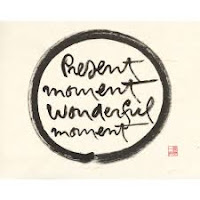
 * calligraphy by Thich Nhat Hanh

Saturday, December 18, 2021

Mindful Writing Mantra Assignment


Design a Mindful Writing Mantra 

[Below is the capstone assignment I give to undergraduate and--with modification--graduate students enrolled in Mindful Writing or Mindful Writing: Theory and Practice. In a subsequent post, I'll be sharing, with students' permission, excerpts from this semester's mantra essays. For background, I'd like to suggest my article, "Mantra of Intention," published in New Writing: International Journal for the Practice and Theory of Creative Writing]

Overview:

The etymology of “mindfulness” is to “remember to remember.” Meditators use a variety of techniques to remember-to-remember, including meditation bells and mantra, or a verbal saying that is repeated or becomes the object of reflection. Ideally, a mantra should be paired with breath-watching, with mindful breathing encoded in the mantra, for example, “Breathing in, I know I am here; breathing out, I know I am here now.” Here’s one of my mantras: “Your Ability to Write is Already Present.” Here’s another, “Present moment, breathing moment, writing moment.”

A mindful writing mantra draws our attention back to the present moment. Resultant changes in our outlook and emotional state can happen within seconds of repeating a mantra, in part because the mantra steers our internal talk, which probably up until that moment had been free-ranging, widely discursive, its self-pathos rhetoric goading us into all sorts of additional mental formations and storylines about our writing.

This project involves designing your own mindful writing mantra in the context of an extended exploration of mindful writing theory and practice. The intent is to make your mantra something you would actually display on your desk or wherever you tend to write—as an object, as a sign, possibly as jewelry—and build that mantra on sound mindful writing concepts.

Stages:

Prewriting: done in class on Thursday 11/18/2021.

Very Rough Draft (minimum 1,000 words) due on Tuesday, 11/30/2021, emailed to apeary@salemstate.edu by class time to receive credit (graded as Complete/Incomplete). No late drafts will be accepted for credit to discourage procrastination (manage that through mindful writing!).

First Draft (minimum 2,000 words) due on Thursday, 12/2/2021. emailed to apeary@salemstate.edu by class time to receive credit (graded as Complete/Incomplete). No late drafts will be accepted for credit.

Second Draft (minimum 3,000 words) due on Tuesday, 12/17/2021 or Thursday, 12/7/2021, depending when your piece is slated for feedback. emailed to apeary@salemstate.edu by class time to receive credit (graded as Complete/Incomplete). No late drafts will be accepted for credit.

Writing Mantra Project (minimum 3,500 words) due by 9 AM on Monday, 12/13/2021. Send as Word attachment.  Doublecheck that I received your project: if you don’t see an email from me on the evening of December 13 indicating that the document was received, it’s your responsibility to contact me immediately to prevent grade point deduction. No projects will be accepted after Tuesday, December 14. Look for emailed feedback and a grade by Friday, December 17.

Steps:

1. Design of a mindful writing mantra:

§ Design the rhetoric of your mantra.

§  Design a visual appearance for your mantra. The examples of mindful calligraphy (from Thich Nhat Hanh) at the top of this exercise sheet are each inside an almost-closed circle. It’s called an ensō. Take a picture of the drawing (or visual elements) or describe how you would design its visual appearance; if the former, email me the picture along with the project.

2. Create a 3,500+ word exploration of mindful writing, connecting your mantra to concepts from the course. Write this in any style that you wish (need not be conventionally academic in tone). Do connect your mantra to course concepts, citing readings, and cover a significant portion of the following:

intrapersonal rhetoric (role in invention or coming up with new material; self-pathos: preconceptions, storylines, mind waves and mind weeds; role in audience proximity—audience demons and ghosts);

verbal emptiness (nonverbal and prewriting);

impermanence (role in invention; groundlessness; interbeing; role in revision);

embodiment (role in invention; verbal emptiness)

mindlessness (non-productive and productive states in your writing experience).

Additionally, address how you plan to use your writing mantra to chip away at writing-related mindlessness. Mention specific phases in a writing process (prewriting, invention, drafting, revising, feedback, editing, etc.) during which the mantra might be useful and how that application might unfold.

Helpful Hints:

·         Use multiple examples from your writing life (brief or extended);

·         Use multiple examples from assigned readings;

·         Talk about your process of creating your mantra;

·         Possibly talk about using the mantra to complete this final project or another writing assignment at the end of this semester: show your mantra in action, whether literally or hypothetically (or both).

Stages:

Prewriting: done in class on Thursday 11/18/2021.

Very Rough Draft (minimum 1,000 words) due on Tuesday, 11/30/2021, emailed by class time to receive credit (graded as Complete/Incomplete). No late drafts will be accepted for credit to discourage procrastination (manage that through mindful writing!).

First Draft (minimum 2,000 words) due on Thursday, 12/2/2021. emailed by class time to receive credit (graded as Complete/Incomplete). No late drafts will be accepted for credit.

Second Draft (minimum 3,000 words) due on Tuesday, 12/17/2021 or Thursday, 12/7/2021, depending when your piece is slated for feedback. emailed by class time to receive credit (graded as Complete/Incomplete). No late drafts will be accepted for credit.

Writing Mantra Project (minimum 3,500 words) due by 9 AM on Monday, 12/13/2021. Send as Word attachment. Double check that I received your project: if you don’t see an email from me on the evening of December 13 indicating that the document was received, it’s your responsibility to contact me immediately to prevent grade point deduction. No projects will be accepted after Tuesday, December 14. Look for emailed feedback and a grade by Friday, December 17.

Steps:

1. Design a mindful writing mantra:

§  Design the rhetoric of your mantra.

§  Design a visual appearance for your mantra. The examples of mindful calligraphy (from Thich Nhat Hanh) at the top of this exercise sheet are each inside an almost-closed circle. It’s called an ensō: https://en.wikipedia.org/wiki/Ens%C5%8D Take a picture of the drawing (or visual elements) or describe how you would design its visual appearance; if the former, email me the picture along with the project.

2. Create a 3,500+ word exploration of mindful writing, connecting your mantra to concepts from the course. Write this in any style that you wish (need not be conventionally academic in tone). Do connect your mantra to course concepts, citing readings, and cover a significant portion of the following:

intrapersonal rhetoric (role in invention or coming up with new material; self-pathos: preconceptions, storylines, mind waves and mind weeds; role in audience proximity—audience demons and ghosts);

verbal emptiness (nonverbal and prewriting);

impermanence (role in invention; groundlessness; interbeing; role in revision);

embodiment (role in invention; verbal emptiness)

mindlessness (non-productive and productive states in your writing experience).

Additionally, address how you plan to use your writing mantra to chip away at writing-related mindlessness. Mention specific phases in a writing process (prewriting, invention, drafting, revising, feedback, editing, etc.) during which the mantra might be useful and how that application might unfold.

Helpful Hints:

·         Use multiple examples from your writing life (brief or extended);

·         Use multiple examples from assigned readings;

·         Talk about your process of creating your mantra;

·         Possibly talk about using the mantra to complete this final project or another writing assignment at the end of this semester: show your mantra in action, whether literally or hypothetically (or both).

* Calligraphy by Thich Nhat Hanh

Monday, December 6, 2021

Guest Appearance on What a Word is Worth Podcast


Mindful Writing: A Conversation with Alexandria Peary 


Host: Dr. Marianela Medrano

What a Word is Worth Podcast: Conversations with Creative People on Collective Healing Using Innovative Means  

Link: What a Word is Worth, Dec 5 2021

This episode is a lively conversation with poet and professor Dr. Alexandria Peary. Here is more about our guest:  Alexandria Peary (MFA, MFA, PhD) serves as New Hampshire Poet Laureate. She is the author of nine books, including Control Bird Alt Delete, Prolific Moment: Theory and Practice of Mindfulness for Writing, and Battle of Silicon Valley at Daybreak. The recipient of a 2020 Academy of American Poets Laureate Fellowship, her work has received the Iowa Poetry Prize; Best of NH (for inspiring artist); several Pushcart and Best of the Net nominations; and Notable Essay in Best American Nonfiction. She specializes in mindful writing and gives talks and workshops on the topic, including a webcast for National Novel Writing Month; a TEDx talk, “How Mindfulness Can Transform the Way You Write”; and the 2021 keynote for the Secondary School Writing Centers Association. Alexandria is the architect and host of the popular webinar on mindful writing for the National Council of Teachers of English.


"Happy Martin Luther King Day: Holding a Jewel of meditation looking into one's own mind, Buddha statue in the lotus mudra, snow, Broadview, Seattle, Washington, USA, Saha Planet Earth, 'Tolerable' (Sanskrit Saha, 'Tolerable' as in 'barely tolerable')" by Wonderlane is marked with CC0 1.0

Wednesday, November 10, 2021

NaNoWriMo Webcast Materials for November 10, 2021


How Mindfulness Can Transform The Way You Write a Novel

A webcast for National Novel Writing Month

Alexandria Peary, MFA, MFA, PhD


Below you'll find info on methods covered during the November 10, 2021 webcast on mindful writing. I've compiled the locations on this blog.


Step 1: Grounding yourself in the writing moment


7 Mindful Breaths:  See the July 19, 2020 post on this blog, "20 Mindful Breaths During COVID-19"

Although this post focuses on mindful breathing to cope with pandemic stress, the same principle applies. Reduce the number of described breaths to as few as seven at the start of your NaNoWriMo writing day.


Yoga for Hands: iFor full version of this method, see the blog post, "Yoga for Hands" posted on April 7, 2020, or September 11, 2012.

Abbreviated Yoga for Hands: Instead of a full body yoga scan, stick just to hands. Start with a brief seated meditation for about one minute. With a gently tall posture, hands on your knees, breathing in, think to yourself, “Here.” Breathing out, think to yourself, “Now.” When your mind wanders away from attention to the breath, gently guide it back. 

Next, move your hands to your keyboard or to your pen/pencil/notebook and begin to freewrite. The topic of this freewrite is the sensation of your fingertips touching the keys or holding the pen/pencil. Do this for a minute. Try to notice moment-to-moment changes in the sensation of writing or typing, continuing to watch your breathing. 

Next, make the topic of the freewrite noticing how your bones are moving inside your writing fingers. Watch the finger bones' complex activity.  Perhaps a simile or metaphor occurs for that activity: what does it remind you of? Continue to watch your breathing. Extend your attention to your palm and the back of your hands as you write. Then turn to your novel, asking yourself, "What's on my mind right now about my novel?" Switch the topic of your freewrite to whatever surfaces in response to that question. 

Summoning Audience Ghosts: See "Make a Caricature of a Tricky  Audience," posted on January 18, 2014, on this blog.

Abbreviated Ghost Hunt:  See my TEDx talk for background information on this desk meditation: How Mindfulness Can Transform the Way You Write  Wait for a moment when you find yourself procrastinating or even slightly hesitating with a piece of writing. Watching your breath, freewrite 250-300 words to the following questions:

-Is there anyone “watching” you right now, reading your writing over your shoulder?

-Who is this person (an audience ghost could be a composite of several people)?

-What’s the audience ghost’s effect on your writing experience?

-If the audience ghost is unhelpful, what’s one measure you could take right now to control their proximity?

Purpose: To become less ensnared by mindless self talk. To better see how we talk ourselves into believing our in-progress writing is already visible to a future reader(s). To take measure to notice our actual writing circumstances—its distance from time and space from future readers.


 Step 2: Observing the Present Moment to Create

Start Where You Are: (Also called "Moment tracking:) After grounding yourself in the present moment, simply ask yourself, "What's next? What's here now for my novel?" Write down anything that arises, without sorting or judging or editing. Keep asking yourself that until you find yourself in an absorbed state of creating. This method allows writing to be a series of now, writing to occur in the moment.


Step 3: Mindful Writer's Self-Care

Loving-Kindness Meditation for Writers:For full method, see "Repost of Loving-Kindness Meditation" from June 13, 2015, on this blog.

Abbreviated Loving-Kindness Meditation: Just do step #2, turning to yourself as a writer. On the in-breath, ask yourself what would bring you happiness as a novel writer or during this NaNoWriMo. On the in-breath. On the out-breath, visualize yourself receiving whatever is this source of writerly happiness. Repeat the question, see what else arises, or stay with the first happiness, watching it in your mind as you watch your breath.


Friday, October 15, 2021

National Novel Writing Month: Mindful Writing Webcast


On Wednesday, November 10, at 2 PM EST, 11 AM, PST, I'll be presenting a mindful writing webcast for NaNoWriMo, National Novel Writing Month: NaNo Calendar

I'll be offering tips on how to reside in the present moment while writing for those courageously creative participants about to embark on a marathon month-long novel writing experience!

If you'd like to join us: https://www.youtube.com/watch?v=W8MvP7oJ41A

If you would like more information about National Novel Writing Month: NaNoWriMo

Description of Session:

This interactive presentation focuses on using mindful writing techniques to help you write your novel during NaNoWriMo. We cover the basics of impermanence, monkey mind, audience ghosts, and preconceptions about writing ability. By residing in the present moment, writers step away from future- or past-oriented worries and create with more ease and satisfaction. Every moment brings us new ideas, if we observe the writing moment with evaluation-free detachment. We practice several techniques to manage perfectionism and readers-in-the-head, plus ways to keep the momentum of your writing going throughout the NaNoWriMo experience.  


Friday, October 8, 2021

"Present Moment, Poetic Moment": Virtual Presentation on October 23, 2021


Registration is now open for this year's 603 Conference, happening virtually on Saturday, October 23. This conference is sponsored by the New Hampshire Writers' Project: Info here about writing conference.


I'll be joining an exciting line-up of presenters and offering my class, "Present Moment, Poetic Moment." If you're curious about how mindfulness can benefit your poetry, register soon:

Description of workshop: This interactive presentation focuses on using mindful writing techniques to write poems. We begin with an overview of the basics of mindful writing, including impermanence, preconceptions about writing ability, monkey mind, and audience ghosts. With a more conscious approach to the writing moment, every moment can become a prolific moment. We discuss how to diminish writing worry from future- or past-oriented thinking and how to reside in the present moment to write with ease and joy. Participants practice several mindful writing techniques and leave the session with a new poem started.

Monday, August 16, 2021

NEW Article on Mindful Writing, "Mantra of Intention"


I've published a new article on mindful writing, "Mantra of Intention," at New Writing: International Journal for the Practice and Theory of Creative Writing

The article will be reprinted in Creative Writing: Stimulus, Intention and Process," forthcoming from Routledge, edited by Graeme Harper.

ABSTRACT

The single most impactful intention a writer can set isn't to work every day, or finish a draft by a circled date on the calendar, or keep submitting work in the face of editorial rejection. It's to prioritize observing the present moment above word count, above stylistic concerns, above reaching a target audience, above any other aspect of composing. From this one simple intention to remain mindful desk-side cascades a series of alterations in our approach to process that causes minor to major stressors to fall to the wayside, leading to increased verbal output and a more positive outlook toward writing. Prioritizing the writing Now annuls our fixation on product or outcome that stunts invention; it helps us better appreciate the nuances of prewriting and the nonverbal; it casts a spotlight on the chimerical nature of the audiences who constrain us; it honors our writing body and our writing emotions.


Other Mindful Resources for You from Me:

Prolific Moment: Theory and Practice of Mindfulness for Writing (Routledge 2018). 

"How Mindfulness Can Transform the Way You Write," TEDx, available on YouTube

"The Role of Mindfulness in Kairos," Rhetoric Review

Mindful Writing Webinar Series for National Council of Teachers of English (scroll down): https://ncte.org/rsvp-mindful-writing-series/

Stay tuned: Mindful Writing How-To Video in conjunction with National Novel Writing Month (NaNoWriMo)

Online Graduate Course in Mindful Writing, Salem State University, September-December 2021 [registration closes soon] https://www.blogger.com/blog/post/edit/8298431477138846862/1285101924950942369